
St. Mary Projected Versus Actual Release
A projected release date is prospective. It is a calculation based on the sentence and the information then held by the legal custodian. An actual release date is retrospective. It records the completed departure from a facility. The St. Mary Parish Sheriff’s released feed can show an actual date and time for a recent departure from the Law Enforcement Center, but it does not provide the time-computation work or a reliable release reason.
A pretrial detainee ordinarily has no sentence-based projected release date. Departure may depend on bond, a court order, dismissal, transfer, or another event. Ask the jail about bond and public holds, then use the court record for the order. A sentenced parish prisoner may have a computed date under the sentence, prior-custody credit, and parish good-time rules. A Louisiana DPS&C prisoner follows the state computation, even if that person is physically housed at the St. Mary Parish facility.
Release, supervision, and discharge must also remain separate. Good-time release or parole can end physical custody while a legal duty continues in the community. A later discharge record shows when that duty ends.
Find a St. Mary Projected Release
Start by naming the legal custodian. The same Centerville building houses local detainees and some Louisiana DPS&C prisoners. Physical location alone does not select the right lookup. Use an exact name and the strongest official identifier available, such as a booking number, DPS&C number, date of birth, or court docket number.
- Decide whether the case is pretrial, a local parish sentence, or a Louisiana DPS&C sentence.
- For pretrial custody, call the St. Mary Parish jail at 337-836-9509 and check the court docket for bond, holds, and orders.
- For a parish sentence, request the jail’s computation and actual-release record. Ask which statute and credits were applied.
- For state custody, use the Louisiana DPS&C Imprisoned Person Locator or call 225-383-4580 for the “projected release date (if applicable).”
- If no date appears, ask whether computation is incomplete or court paperwork is still pending. Do not translate a blank field into a sentence conclusion.
- Check court orders, consecutive or concurrent terms, warrants, detainers, and parole action before treating the date as current.
- After departure, verify the actual timestamp through the St. Mary Sheriff or Louisiana DPS&C record.
The state locator result must be read by its exact field label. Possible, projected, tentative, full-term, and parole-eligibility dates are not interchangeable. The official Victim/Survivor Guidebook sends possible-release-date inquiries to the same state locator number.
The following image is a successful capture of the Louisiana DPS&C locator and released or discharged result path.
It illustrates why a state record should be checked for legal status and location rather than reduced to one date.
The broader St. Mary Parish released-inmate search supplies the local release-record and court fallback when the state locator is not the right source.
St. Mary Release Date Calculation
An official computation starts with the imposed term and its commencement. The custodian then applies court-awarded credit for prior custody, determines whether sentences run at the same time or one after another, selects the governing statute version, posts credit earned or lost, and accounts for later court, parole, or warrant events. A public user cannot safely reconstruct the answer from a sentence length and a broad percentage.
The legal sequence is best stated as a flow: sentence and start date → prior-custody credit → consecutive or concurrent structure → correct good-time regime → credits earned, forfeited, or restored → later orders and holds → official projected date → actual release record.
Louisiana DPS&C says its automated date information is available only after a calculation exists. Soon after sentencing, the agency may still await official court papers. The DPS&C time-computation FAQ provides that operational limit and lists the time-computation automated line at 225-342-0799.
The successful manifest image below comes from that official time-computation FAQ.
The agency guidance supports a narrow reading of a blank field: computation may be incomplete, so the absence of a date proves no broader status.
Note: Always ask the custodian for its current date instead of applying a broad percentage to a sentence.
St. Mary Parish Good-Time Rules
Louisiana parish and state good time are not one rule. For eligible parish prisoners sentenced without hard labor under the older framework, R.S. 15:571.3(A) generally states thirty days of diminution for each thirty days in actual custody. Diminution means a lawful reduction in time to be served. A first conviction for a crime of violence uses three days for each seventeen days actually served, while the statute excludes specified repeat violent convictions. The parish sheriff has statutory authority to determine when parish credit is earned under the law and regulations.
Eligible Louisiana DPS&C felony offenders fall under other subsections with offense and history limits. The older nonviolent state rate often cited is thirteen days of diminution for each seven days served. The three-for-seventeen cycle means seventeen days served in a twenty-day cycle, which produces the familiar 85 percent shorthand. That figure is not a universal Louisiana release rule. It describes one rate, not every prisoner.
The official R.S. 15:571.3 text is shown in this successful manifest capture.
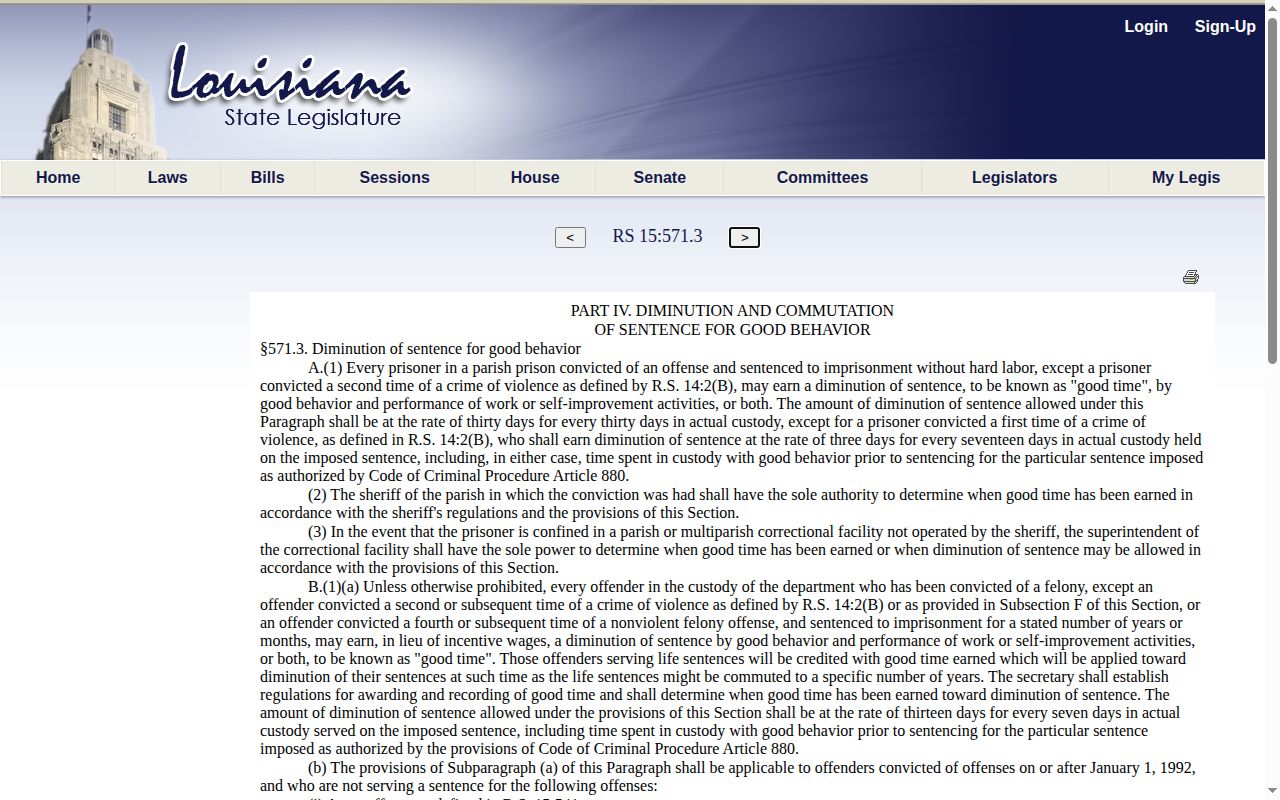
The statute’s separate parish and state provisions are the reason the legal custodian must be identified before a rate is discussed.
St. Mary Post-2024 Release Dates
Offense date controls which good-time framework applies. For offenses committed on or after August 1, 2024, R.S. 15:571.3.1 is the newer framework. It permits an eligible felony offender in parish prison or Louisiana DPS&C custody to earn good time up to a maximum of fifteen percent of the imposed sentence. It excludes sex offenses as defined by law and habitual-offender sentences under the cited statute.
The newer law separately permits certain additional diminution and addresses prior-custody credit, forfeiture, and release to unsupervised parole for the balance of the full term. Thus, “serve exactly 85 percent” can still be too simple. A person’s eligibility, offense class, credited time, and later events remain part of the official calculation.
This successful capture shows the post-August 2024 good-time statute.
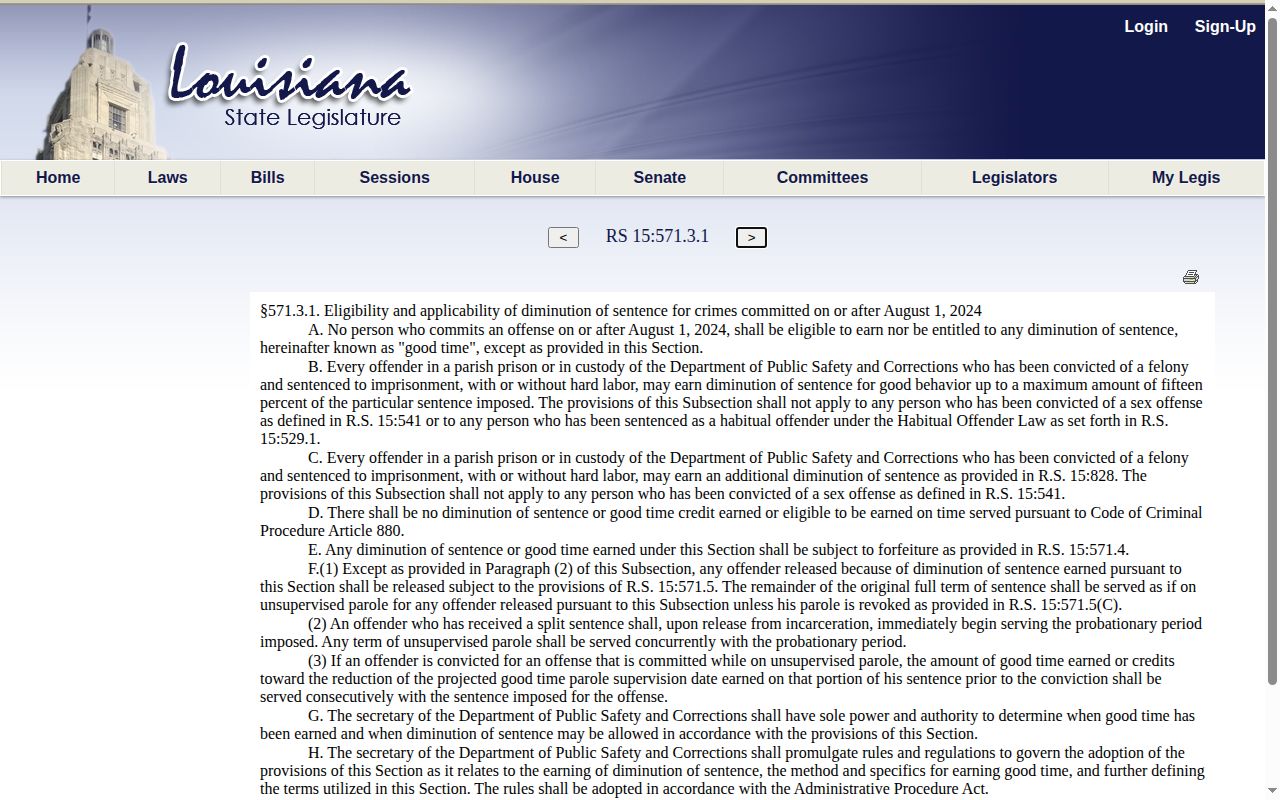
The effective-date split prevents an older rate from being applied to a newer offense, or a newer cap from being imposed on an older case without legal support.
St. Mary Pre-2024 Release Credits
For an offense committed before August 1, 2024, R.S. 15:571.3 remains material. The older law contains several rates and exclusions keyed to parish or state custody, violence, sex offenses, criminal history, and offense date. Its subsection H directs later offenses to the newer statute. This makes the offense date a threshold fact, not a minor detail. The commitment and conviction record should identify the facts needed for the legal custodian’s computation.
Related laws can also alter the result. R.S. 15:571.4 addresses forfeiture of good time for escape and disciplinary grounds. R.S. 15:571.5 explains release by diminution and parole-like conditions, while R.S. 15:537 restricts diminution for listed sexual offenses. These provisions show why a credit rate alone cannot produce a reliable date.
Parole eligibility is also distinct from good-time release. The Committee on Parole may consider an eligible case under its laws and rules, but a hearing, a grant, and actual release are separate events. Conditions, plan review, processing, or another hold can remain after a favorable decision.
Why St. Mary Release Dates Change
A projected date changes when one of its inputs changes. The adjustment may come from conduct credit, a new legal order, another custody claim, or a parole action. The official custodian must recalculate the date and label it correctly.
| Factor | Effect on the date | Record to check |
|---|---|---|
| Credit earned or restored | May move an eligible projected date earlier | Official time computation |
| Credit forfeited | May move the date later after authorized discipline | Credit and disciplinary computation |
| Prior-custody credit | Changes the credited time already served | Court commitment and custodian computation |
| Consecutive sentence | Adds a term after another instead of running together | Sentencing judgment |
| Detainer or warrant | May block community release or route the person to another custodian | Hold record and receiving agency |
| Court order | Can amend, vacate, or otherwise alter the sentence | Signed order or minute entry |
| Parole action | May create eligibility or a conditional release path, but not instant departure | Committee decision and DPS&C record |
A detainer is a request or hold from another authority. Transfer under a detainer is not community release. Likewise, a parole hearing date is not a projected gate date. Check the decision, conditions, actual release processing, and the assigned supervision office.
Note: A local actual release timestamp proves departure from St. Mary custody, not freedom from every other hold.
Confirm St. Mary Actual Release
For a St. Mary Parish jail departure, compare the official projected information with the Sheriff’s actual released entry or custody record. The rolling feed offers a short public window and an actual timestamp. If the entry is new or unclear, call 337-836-9509. Ask whether the public date marks completed physical departure and whether another agency received the person.
For Louisiana state custody, get a fresh DPS&C answer. The state’s Victim Services page also explains that LAVNS enrollment differs from Victim Outreach registration for actual or projected state-prison release notices. The St. Mary VINE inmate check covers the person-specific alert steps and that separate enrollment rule.
When a date matters for a court or records process, preserve the exact label, access date, identifier, and source. Then obtain the underlying computation or release record. Do not call a person fully discharged unless the responsible agency records the end of both custody and any supervision obligation.